
What Is a Cookie Policy in 2026? 7 Live Checks Before You Publish One
A useful guide to what is a cookie policy should help readers understand both the rule and the behavior behind the rule. That is where consent topics become genuinely practical instead of sounding like recycled compliance copy.
The practical review for what is a cookie policy starts when you look past the banner copy and test the live behavior. That is usually where teams find the real gaps: tags firing too early, weak refusal flows, and settings that drift after routine site changes.
That answer sounds simple, but the live version is more operational than most teams expect.
Your Europe still says websites using consent-based cookies must give users “clear and comprehensive information” about the cookies and their purpose, and it must be “as easy for your users to withdraw” consent as it was to accept. The ICO’s current UK guidance says you must “tell your users about any third parties” and give people granular options by purpose. California’s DOJ, meanwhile, still distinguishes between the narrower notice-at-collection layer and the broader privacy policy, which it describes as giving the fuller “broad picture” of collection, use, sharing, and sale practices.
So when someone asks what is a cookie policy, I would not answer with just a legal page about cookies.
I would answer with this:
it is the tracking-specific disclosure layer that has to match the live runtime, the consent controls, and the broader privacy-rights flow.
If you want the closest companion reads first, start with these guides to cookie policy, do i need a cookie policy on my website, and cookie policy template. This page stays focused on what is a cookie policy and the practical checks I would use this week before publishing one on a real site.
If your team is trying to get what is a cookie policy under control without adding a heavyweight privacy stack, DataShyre can help. DataShyre focuses on consent and preference management that are easier to implement, easier to operate, and easier to trust on a live site. Start with DataShyre’s consent and preference management or book a demo.
If your banner, settings panel, and policy page are telling three different stories, DataShyre can help audit the runtime, clean up the policy language, and connect the consent layer to what the browser is actually doing in production.
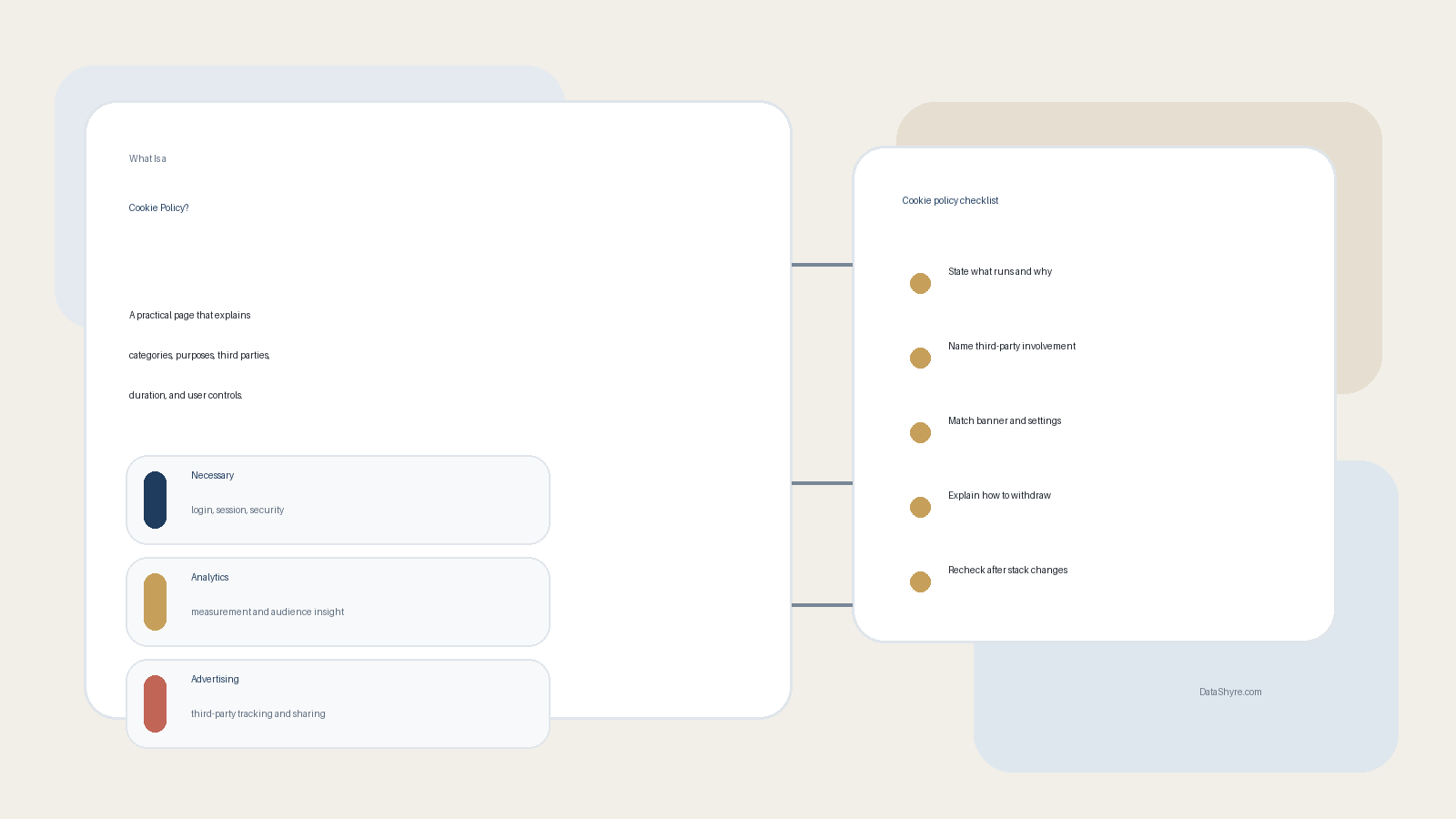
1. A cookie policy explains technologies and purposes, not just that cookies exist
The first what is a cookie policy mistake is thinking the page only needs to say:
we use cookies to improve your experience
That is not enough.
A real cookie policy should help a normal person understand at least:
- what categories of technologies the site uses;
- what those categories are for;
- whether they are necessary or optional;
- whether third parties receive data; and
- how the user can manage the related choice.
This is why the phrase what is a cookie policy points to more than a glossary page. It should describe actual site behavior in plain language, not hide the operational detail behind generic marketing wording.
2. A cookie policy should separate necessary functions from optional tracking
This is where the page becomes useful or decorative.
Your Europe still draws a practical line between cookies that are necessary for a service the user requested and cookies that need consent. The ICO’s current guidance does the same thing from a UK implementation angle by tying consent to purpose and by requiring granular options for non-exempt uses.
So when someone asks what is a cookie policy, one useful answer is:
it is the page where you show which technologies are genuinely necessary and which ones serve optional measurement, personalization, advertising, or cross-site tracking purposes.
In real deployments, that usually means the policy should distinguish between:
- login, cart, security, and session continuity;
- analytics and audience measurement;
- personalization and preference memory;
- advertising and retargeting;
- embedded tools like maps, chat, video, or social widgets.
If those categories are flattened into one bucket, the policy stops helping users make sense of the controls they see elsewhere.
3. A cookie policy should identify third parties and duration, not just categories
This is one of the clearest places where weak policies fall apart.
The ICO’s current guidance says you must tell users about third parties and make specific information about each one available. That means what is a cookie policy cannot honestly be answered with a short notice about first-party cookies.
A stronger cookie policy usually helps the user understand:
- whether the identifier is first-party or third-party;
- which provider is involved;
- what the provider helps the site do;
- whether the identifier is session-based or persistent; and
- where to go if the person wants to revisit the choice later.
That does not always require a giant vendor spreadsheet in the middle of the page. But it does require enough specificity that the page can be matched to the live stack and to the settings interface.
4. A cookie policy must line up with the banner, reject path, and withdrawal path
This is the part that changes what is a cookie policy from drafting work into control work.
Your Europe still says consent withdrawal must be as easy as acceptance. The ICO says consent requests must be purpose-specific and the mechanism has to function as intended. CNIL’s current cookie FAQ still expects refusal to be as easy as acceptance.
So a cookie policy should not promise control in abstract terms.
It should match the controls people can actually reach.
That means a serious what is a cookie policy review should compare the page against:
- the first-layer banner;
- the
accept allandreject allbehavior; - the preference-center category labels;
- the later
manage cookiesorprivacy settingsroute; and - the mobile version of those same controls.
If the cookie policy says users can change preferences any time, but the settings route is hidden, broken, or missing on some templates, the page is not really describing the experience users get.
5. A cookie policy is not the same as the broader privacy policy
This is one of the easiest what is a cookie policy questions to answer clearly.
California’s DOJ still says the notice at collection must be available at or before collection and link to the privacy policy for fuller detail. The same DOJ overview describes the privacy policy as the written statement that gives the broader picture of collection, use, sharing, sale, and rights.
That makes the practical split much easier:
- the privacy policy covers the wider personal-data lifecycle and consumer rights;
- the cookie policy goes deeper on browser-side and device-side tracking technologies, categories, purposes, third parties, and controls.
That distinction matters because a site can have:
- a decent cookie page, but weak California notice-at-collection wording;
- a visible banner, but no clear
Your Privacy Choicesroute where sale or sharing rights apply; or - a broad privacy policy, but almost no real explanation of tracking technologies.
So if someone asks what is a cookie policy, the right answer is not your entire privacy program in one page. It is one important page inside the wider privacy program.
6. A cookie policy in 2026 should cover more than classic browser cookies
This is the biggest scope trap.
The ICO’s April 2026 guidance is broader than classic cookies alone. It expressly covers tracking pixels, device fingerprinting, scripts, tags, and similar storage-and-access technologies. That means a modern answer to what is a cookie policy should usually include more than named browser cookies with expiry dates.
The page should also account for things like:
- tag-manager controlled scripts;
- pixels or event beacons;
- embedded media and support widgets;
- fraud, bot-detection, or measurement tools;
- other technologies that store or read information from the device.
If the policy is written as if the site only uses a few obvious browser cookies, it may already be stale before the next plugin, embed, or marketing tag goes live.
7. A cookie policy should have update triggers, not just a publish date
The long-term answer to what is a cookie policy is not a page you wrote once.
It is a page that stays true when the site changes.
That usually means rechecking the page when:
- a new vendor or plugin is added;
- an analytics or ad tag changes;
- the CMP categories are renamed;
- a new region-specific rule or rights path is added;
- embedded tools are added to high-traffic pages; or
- the privacy notice or opt-out flow changes.
This is also where a lot of teams need implementation help. If your cookie policy is technically accurate only for an old version of the site, DataShyre can help tighten the inventory, the consent flow, and the policy language so they stay aligned.
A practical answer for this week
If I were answering what is a cookie policy for a live business today, I would use this definition:
it is the tracking-specific explanation page that tells people what browser-side or device-side technologies are in use, why they are used, whether third parties are involved, how choices work, and how that control connects to the broader privacy-rights experience.
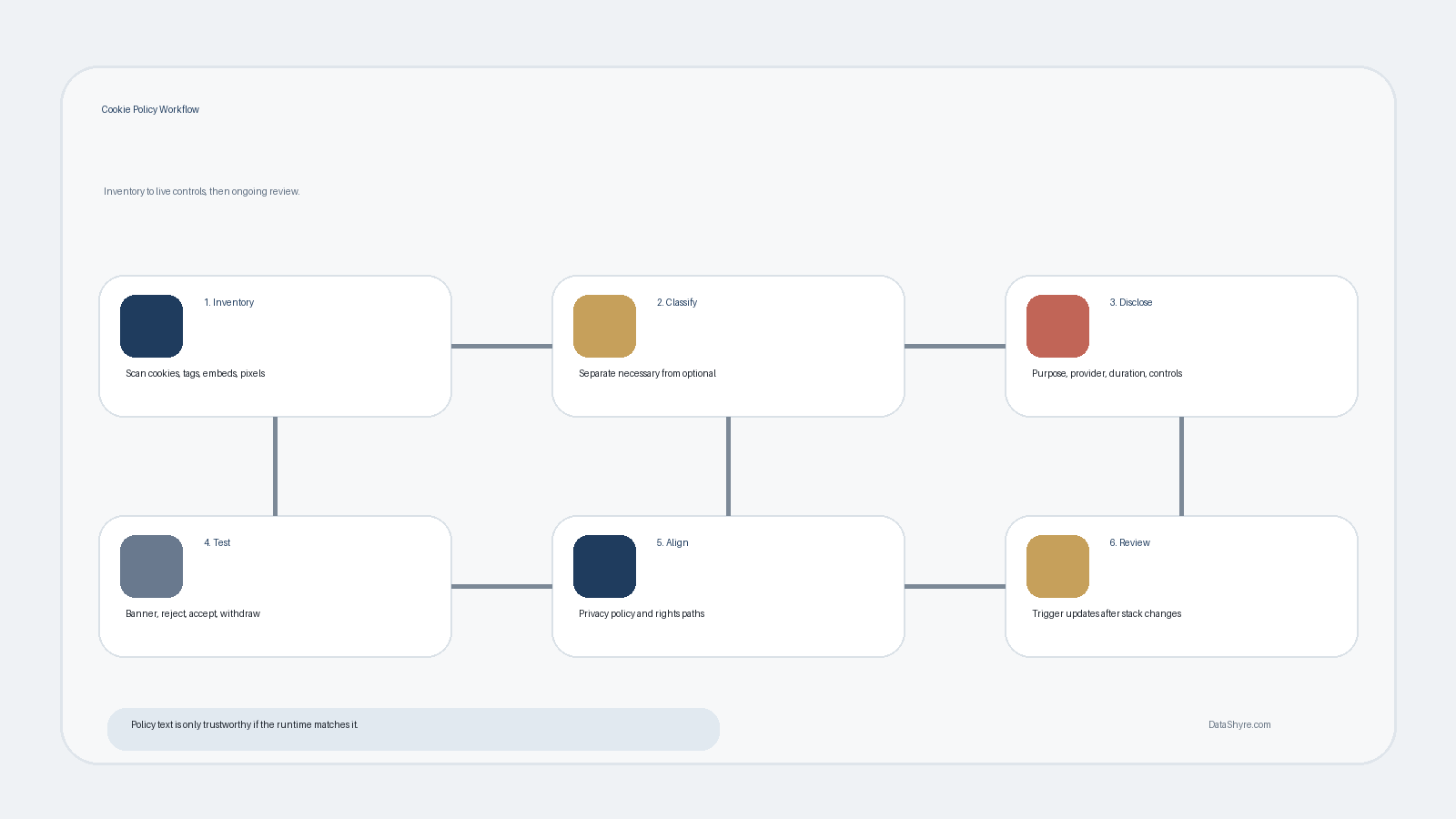
And if I were reviewing one this week, I would do it in this order:
- inventory the technologies that actually load;
- separate necessary from optional behavior;
- document categories, purposes, providers, and duration;
- compare the page against the banner and settings flow;
- align it with the privacy policy and any California rights paths; and
- set the next re-review trigger before the next meaningful release.
That sequence answers the real question behind what is a cookie policy much better than polishing the wording first.
FAQ
What is a cookie policy in simple terms?
It is the page that explains what cookies and similar tracking technologies your site uses, why they are there, whether third parties are involved, and how people can control them.
Is a cookie policy the same as a privacy policy?
No. A cookie policy focuses on tracking technologies, categories, providers, duration, and controls. A privacy policy covers the wider collection, use, sharing, retention, and rights picture.
Does every cookie policy need a banner too?
Not always in the same way everywhere, but if your site uses optional tracking technologies in places where consent is required, the policy and the consent control layer need to match each other.
Can a cookie policy fix a bad consent setup by itself?
No. A cookie policy can explain the setup, but it cannot make the runtime lawful or technically effective on its own.
Bottom line
The best answer to what is a cookie policy in 2026 is not a legal page about cookies.
It is a live disclosure layer for tracking technologies that has to stay aligned with your inventory, your consent controls, your third-party stack, and your broader privacy-rights experience.
If those pieces do not match, the page is only performing transparency.
Seen clearly, what is a cookie policy is less about a pop-up and more about whether the site behaves honestly after the visitor makes a choice.
Official sources used
- Your Europe: Online privacy and website cookies
- ICO: How do we manage consent in practice?
- ICO: Final storage and access technologies guidance published
- California Attorney General: California Consumer Privacy Act
- California Privacy Protection Agency FAQ
- California Privacy Protection Agency regulations text, section 7026
- CNIL cookie and trackers FAQ