
Cookie Policy Example in 2026: 7 Checks Before You Copy One
A useful guide to cookie policy example should help readers understand both the rule and the behavior behind the rule. That is where consent topics become genuinely practical instead of sounding like recycled compliance copy.
The practical review for cookie policy example starts when you look past the banner copy and test the live behavior. That is usually where teams find the real gaps: tags firing too early, weak refusal flows, and settings that drift after routine site changes.
That is where the current official sources still line up. The ICO says users need “clear and comprehensive information” about storage and access technologies. GDPR Article 7 still says it must be “as easy to withdraw as to give consent.” CNIL still says rejecting cookies should be “just as easy as accepting them.” And when the ICO finalized its broader storage-and-access-technologies guidance in April 2026, it said the goal was giving people “meaningful control over how their data is used.”
This is why a strong cookie policy example is not copy.
It is a benchmark.
If you want the closest companion reads first, start with these guides to cookie policy, cookie policy template, and privacy policy template. This page stays narrower. It is the cookie policy example review I would use this week before borrowing language from any generator, law-firm sample, CMP export, or competitor page.
If your team is trying to get cookie policy example under control without adding a heavyweight privacy stack, DataShyre can help. DataShyre focuses on consent and preference management that are easier to implement, easier to operate, and easier to trust on a live site. Start with DataShyre’s consent and preference management or book a demo.
1. Treat the example as a comparison tool, not the source of truth
The first cookie policy example mistake is assuming the example knows your site better than your browser trace does.
It does not.
An example can suggest structure.
It cannot tell you:
- which cookies or similar technologies are active right now;
- which provider sets them;
- which page templates trigger them;
- which ones are necessary versus optional; or
- whether your current banner logic actually changes runtime behavior.
So the example should be the shell.
Your live inventory is the truth.
2. Make sure the example names categories, providers, and duration
A weak cookie policy example usually sounds like this:
we use cookies to improve your experience
That may read smoothly, but it is too vague to be useful.
The better examples do more than name categories. They also explain what the category does, who is involved, and how long the identifier stays active.
If I were grading a cookie policy example, I would want it to help answer:
- what category the technology belongs to;
- what practical purpose it serves;
- whether your company or a third party sets it;
- whether it is session-based or persistent; and
- where the user can manage the related choice later.
If those details are missing, the example is closer to a glossary than a disclosure.
3. Separate necessary functions from optional tracking
This is the fastest way to tell whether a cookie policy example is operational or decorative.
The ICO’s broader tracking guidance still turns on a meaningful distinction between essential functions and optional tracking behavior. So a usable cookie policy example should not flatten everything into one list.
It should clearly separate:
- security, session, cart, or login functions;
- analytics and measurement tools;
- personalization features;
- advertising or cross-site tracking;
- embedded tools that bring in third-party tracking.
If the example treats all of those categories as morally or technically equivalent, it is not helping users understand what is really happening.
4. Compare the example against the banner, reject path, and withdrawal path
A cookie policy example cannot be correct by itself.
It has to line up with the actual consent journey.
GDPR Article 7 still says withdrawal must be “as easy to withdraw as to give consent.” CNIL’s cookie-banner enforcement still says refusal should be “just as easy as accepting them.” That means the page behind the banner cannot promise controls the interface does not deliver.
So when I review a cookie policy example, I compare it against:
- the first-layer banner copy;
- the
accept allandreject allcontrols; - the category labels inside the settings panel;
- the later
manage cookiesorprivacy settingsroute; and - the actual behavior after a user changes their mind.
If the example says people can withdraw at any time, that path should be easy to find and easy to use on mobile too.
5. Make sure the example covers more than classic browser cookies
The strongest 2026 warning sign is still over-narrow drafting.
The ICO’s current guidance is broader than classic browser cookies alone. It covers storage and access technologies more generally, including related tracking mechanisms and similar technologies used to observe or influence user behavior.
That means a serious cookie policy example should help you account for more than a simple cookie table. I would expect the review to include:
- pixels;
- scripts loaded through a tag manager;
- video, chat, map, and social embeds;
- CAPTCHA or bot-detection tools;
- other third-party components that place or read identifiers.
If the example only fits a simple brochure site, it may fail the moment your real stack includes marketing embeds or vendor-side tracking logic.
6. Keep the example aligned with the wider privacy notice and rights flow
A cookie policy example should go deeper on tracking details.
It should not pretend to be the entire privacy program.
That matters even more for U.S.-facing teams. California’s privacy framework still gives people rights around selling or sharing personal information, and a cookie page alone does not replace those broader disclosures or choice paths.
In real deployments, a usable cookie policy example should support a wider disclosure system where:
- the cookie page explains technologies, categories, duration, and controls;
- the broader privacy notice explains collection, use, sharing, retention, and rights;
- the preference or opt-out paths are described consistently across both pages.
If those documents tell slightly different stories about vendors, categories, or choice routes, the example has already failed.
7. Add update triggers so the example does not freeze while the site changes
The biggest long-term cookie policy example risk is drift.
The page can be accurate on launch day and misleading a week later.
That usually happens when:
- a new analytics or ad-tech vendor is added;
- a plugin changes load order;
- a new embed appears on a landing page;
- the CMP categories or defaults are renamed;
- a tag-manager container is updated;
- a region-specific rule changes.
That is also where DataShyre can help. If your team has a sample policy that looks polished but no longer matches the runtime, DataShyre can help audit the live site, map vendor behavior, and tighten the consent implementation so the published text matches what the browser is actually doing.
A practical cookie policy example review for this week
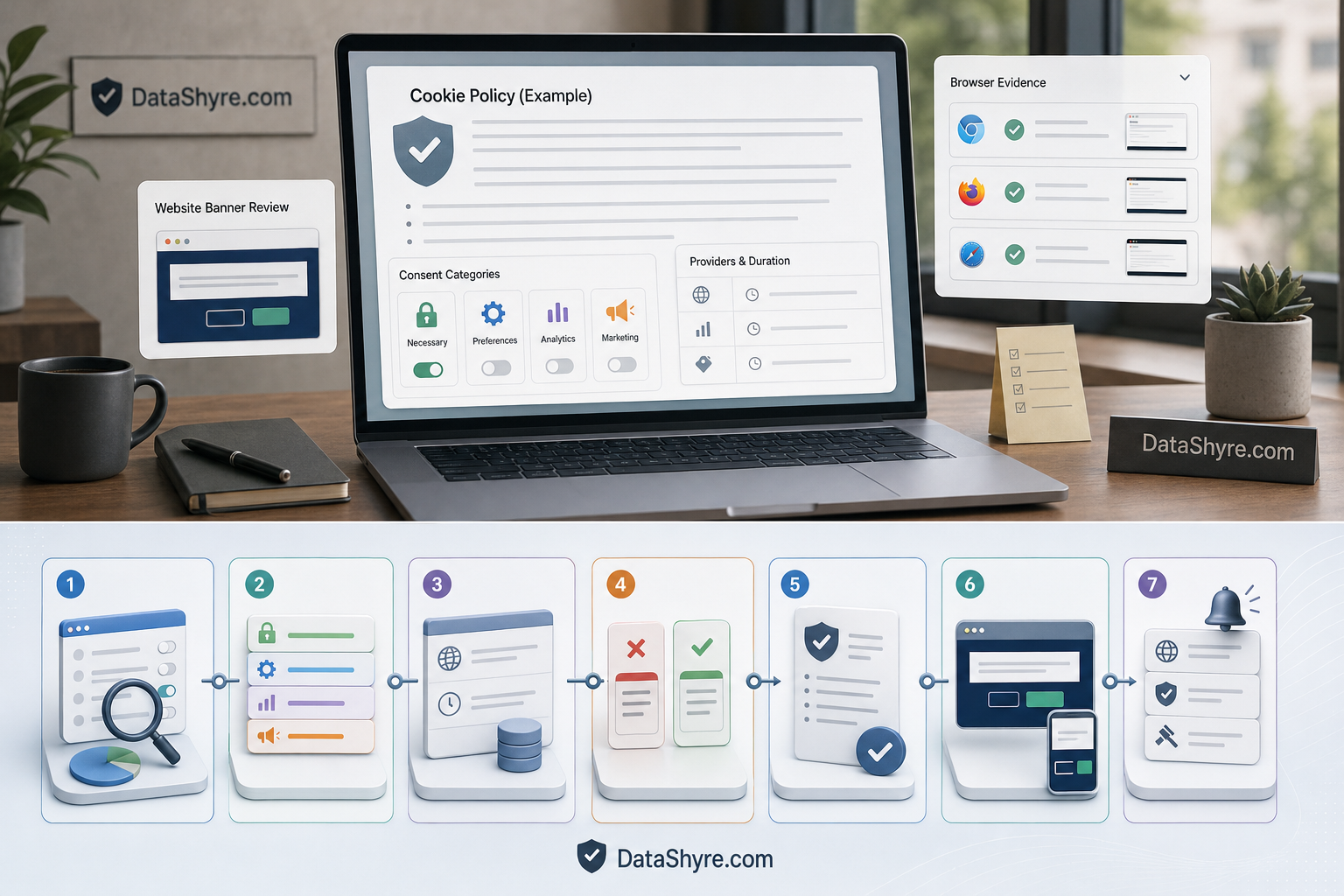
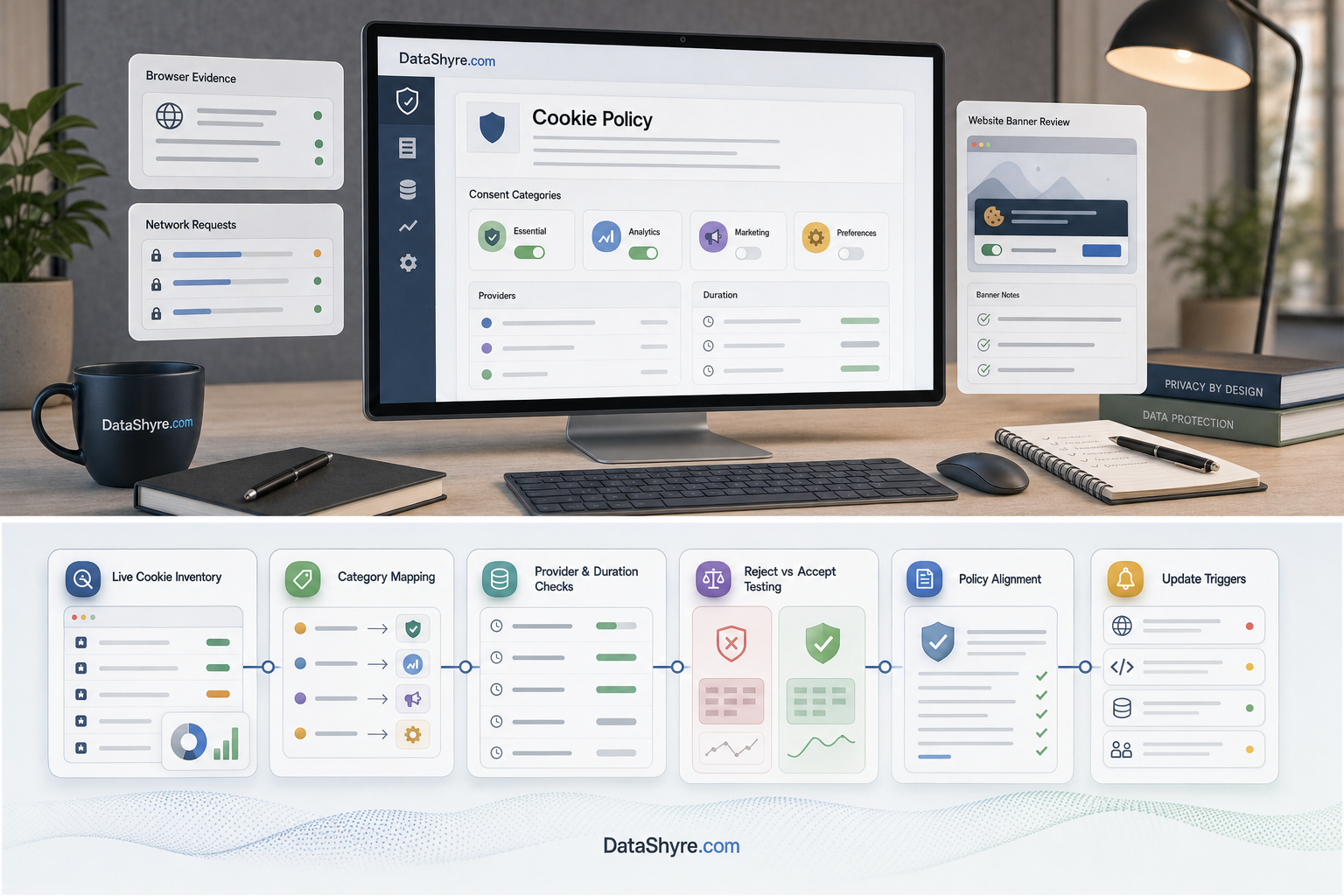
If you were reviewing a cookie policy example today, use this order:
- inventory the live technologies and related providers;
- classify necessary versus optional behavior;
- document category, purpose, provider, and duration;
- compare the example against the banner and settings flow;
- align it with the wider privacy notice and choice routes; and
- set the next re-review trigger before the next release.
That catches more real problems than polishing the wording first.
FAQ
Is a cookie policy example enough by itself?
No. A cookie policy example can help with structure, but it cannot verify what your live site loads, who receives data, or whether refusal and withdrawal actually work.
What should a cookie policy example include?
At minimum, it should help you describe categories, purposes, providers, duration, third-party involvement, consent logic, and how users can refuse or later change their choices.
Is a cookie policy example the same as a privacy policy example?
No. A cookie policy example goes deeper on device-level technologies and consent controls. A privacy-policy example covers the wider collection, use, sharing, retention, and rights picture.
Bottom line
The best cookie policy example in 2026 is not the one with the most polished boilerplate.
It is the one you use as a checklist while comparing categories, providers, duration, refusal, withdrawal, and third-party behavior against the live site you actually run.
If that comparison step is weak, the example has not solved the problem.
Seen clearly, cookie policy example is less about a pop-up and more about whether the site behaves honestly after the visitor makes a choice.
Official sources used
- ICO, Guidance on the use of storage and access technologies: https://ico.org.uk/for-organisations/direct-marketing-and-privacy-and-electronic-communications/guidance-on-the-use-of-storage-and-access-technologies/
- ICO, Final storage and access technologies guidance published: https://ico.org.uk/about-the-ico/media-centre/news-and-blogs/2026/04/final-storage-and-access-technologies-guidance-published/
- EUR-Lex, Regulation (EU) 2016/679 (GDPR): https://eur-lex.europa.eu/eli/reg/2016/679/oj/eng
- CNIL, Dark Patterns in Cookie Banners: CNIL issues formal notice to website publishers: https://www.cnil.fr/en/dark-patterns-cookie-banners-cnil-issues-formal-notice-website-publishers
- CPPA, Frequently Asked Questions (FAQs): https://www.cppa.ca.gov/faq.html